The Lowell Cemetery is a non-municipal and non-denominational cemetery.
77 Knapp Ave, Lowell, MA 01852 | 978-454-5191
Lieutenant-Governor John Nesmith was prominent in its politics, and acted as treasurer in 1819-20, and represented the town in the General Court in 1821.
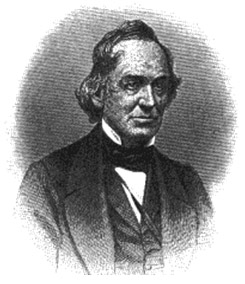
Lieutenant-Governor John Nesmith was born in Windham, New Hampshire, on August 3, 1793. Up until his twenty-ninth year, his life was intimately connected with the history of Windham, and he actively mingled in its affairs. In 1822, he moved to Derry, NH.
The story of his life will be found in the following article, which I take from the Annual Cyclopedia (1869), written by John-Bell Bouton:
“John Nesmith, one of the most enterprising and successful of New England manufacturers, was b. in Windham, New Hampshire, August 3, 1793; died October 15, 1869. Mr. Nesmith commenced life as a poor boy and had only the common advantages of education at that time. At fourteen years of age, he was placed in a country store and served an apprenticeship of five years, after which, in connection with his brother Thomas, he went into business for himself. As soon as their cash capital and enlarged credit would warrant the adventure, the brothers moved to New York and built up an extensive and highly remunerative trade. In 1831, foreseeing the future importance of Lowell, Mass, as a manufacturing center, they settled in that place, invested largely in real estate, and identified themselves with every measure calculated to advance the growth and prosperity of the home of their adoption. Mr. Nesmith’s peculiar tastes and talents soon enlisted him in the manufacture of blankets, flannels, printing-cloths, sheetings, and other textile fabrics, and from thenceforth that was his principal pursuit. He became agent for, or as owner was interested in, mills in Lowell, Dracut, Chelmsford, Hooksett, and other places, and managed those enterprises with almost unvarying success. He was a large stockholder in the Merrimack Woolen Mills Company.”
“Appreciating more than any other man the natural advantages of the water-powers which have made Lowell what she is, he bethought himself of securing the supply of water in Winnisiseogee and Squam Lakes in New Hampshire as reservoirs for the Lowell mills in dry seasons, and letting it into the Merrimack by artificial channels. This brilliant conception was at first scouted as impracticable by manufacturers along the river, but Mr. Nesmith, satisfied that they would at last require the additional water, bought the right to use both those lakes for the purpose named, and the manufacturers were before long obliged to purchase it from him. Mr. Nesmith was the first to discern the natural fitness of the site now occupied by the flourishing city of Lawrence, on the Merrimack, for a manufacturing point, and made heavy purchases of lands on both sides of the river, securing also the necessary charter to control the water-power. About 1844, his bold scheme attracted the attention that it deserved from Boston capitalists, and factories began to rise at Lawrence as if by magic, and that city has since most amply vindicated the wisdom of its real founder.”
“While Mr. Nesmith was carrying on these multifarious and arduous undertakings, he devoted his odd hours to philosophical and mechanical studies, in which he became much more than an amateur. Several of his discoveries and inventions were of great importance and value, among others, the well-known machinery for making wire-fence and shawl fringe. Though naturally averse to mingling in politics and never stooping to the acts by which popularity is often won, he was elected to various offices in the city government of Lowell, where his sound practical sense and extraordinary business capacity were acknowledged and prized by his fellow citizens with distinction of party. He was a presidential elector from Massachusetts in the college which chose Mr. Lincoln for both terms; was lieutenant-governor of Massachusetts in 1862; declined a re-election in 1863, and was afterwards appointed United States collector of internal revenue for his district, which office he filled ably and acceptably until his resignation, twelve days before his death. Mr. Nesmith’s attachment to the principles of his party was that of the moralist rather than the partisan, and he never ceased to command the respect of his political opponents. The temperance cause in Massachusetts early engaged his hearty support and liberal contributions, and he was for some time a vice-president of the State Alliance. From the large fortune acquired by his tact and industry, he made generous donations to many objects of charity and benevolence which won upon his sympathy, and was invariably hospitable and kind to his friends and neighbors. In his domestic relations, he was especially tender and affectionate. His will made handsome provision for the foundation of a ‘Nesmith Fund’ for the care, support, education, and maintenance of the indigent blind of New Hampshire, and also a public park in the town of Franklin, in the State.”
“The secrets of Mr. Nesmith’s career may easily be found, not more in his high mental endowments, than in his unflagging industry, his indomitable perseverance, his strict integrity, and the concentration of all his faculties and energies on the successive objects in hand, and those temperate and well-ordered habits of life which down to it’s close preserved his mind in all its youth and buoyancy. He offered a rare illustration of what an active intellect may accomplish, aided by courage and fixity of purpose, and animated by principles of truth, justice, and honor.”